


Brooklyn · garages, basements & commercial slabs
Epoxy flooring & polished concrete in Brooklyn
Gemini Floor Services is a family-owned flooring company working out of 229 Sumter St in Bed-Stuy, so concrete jobs anywhere in Brooklyn are close to home for our crew. As your flooring contractor we inspect the slab, handle repairs and grinding, and then either build a resin coating system or polish the concrete itself. Owner Dyal Ramna has been in the trade for more than 30 years.
Neighborhoods we serve: Park Slope, Brooklyn Heights, Bay Ridge, Williamsburg, Bushwick, Prospect Heights, Flatbush, Sunset Park, Carroll Gardens, Midwood, Borough Park, Crown Heights, Bed-Stuy, DUMBO.
Concrete floors that work hard in Brooklyn
Plenty of Brooklyn slabs were poured as bare structure and never meant to be looked at: row-house cellars in Bed-Stuy, detached garages in Midwood, storefronts along Flatbush Avenue, and warehouse lofts in Bushwick and Sunset Park. With the right treatment, that gray concrete can become a durable, easy-care surface. We offer two main paths. A resin coating builds a new layer on top of the slab, while polishing refines the concrete you already have.
The choice depends on how the room is used, how the slab looks today, and how much moisture comes up through it. We check all three before recommending a system, and we tell you plainly if the slab needs repairs first.
Epoxy coating systems
A professional epoxy floor is a stack of layers, not a single coat of paint. It starts with a primer that seals the concrete, acts as a moisture barrier and helps the build coats bond without bubbling. Next come one or more epoxy build coats, applied by roller, trowel or as a self-leveling pour when the job calls for it. A clear urethane topcoat finishes the system, adding toughness and resistance to UV yellowing.
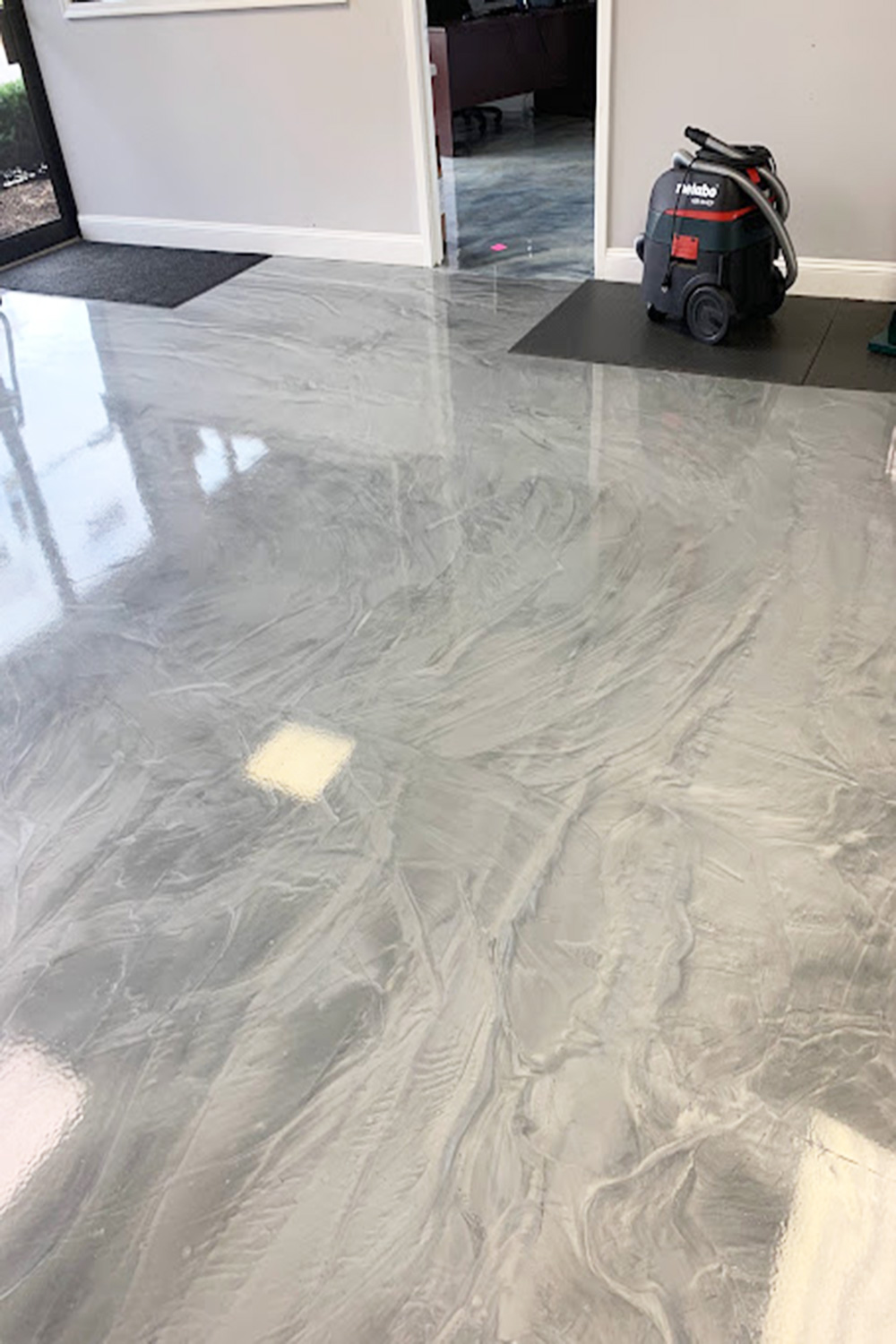
Decorative options are wide. Solid colors suit shops and utility rooms. Flake or chip broadcast hides dirt and adds texture, which many owners like in a garage. Quartz broadcast gives extra grip, and metallic powders create a swirled, glossy look for showrooms or finished basements. Logos, safety lines and markings can be built in too. More background is on our main epoxy and polished concrete page.
Polished concrete
Polishing uses no coating film at all. We grind the slab with progressively finer diamond tooling, then apply a penetrating densifier that hardens the surface, cuts down on concrete dusting and helps resist stains. Sheen ranges from a flat Class 1 up to a high-gloss Class 4, and the grind depth decides how much aggregate shows, from a smooth cream finish to exposed large stone. Stains, dyes and decorative saw cuts can add color and pattern.
We prefer a dry diamond method with the dust captured at the machine, keeping the work dust-controlled. A quicker grind-and-seal option uses a topical sealer instead of a full mechanical polish; it gets you there faster but needs resealing more often. Brand-new concrete must fully cure, often 30 to 60 days, and pass a moisture meter check before we polish or seal it.
How a Brooklyn concrete job runs
Visit and scope
We look at the slab, talk about how the space gets used, slip concerns and downtime, and help you pick flake, metallic, self-level or a polished finish.
Test and repair
Moisture and bond conditions are checked, since they decide the primer. Cracks, joints and pits are filled, and old coatings are ground off.
Grind the surface
Diamond grinding opens up the concrete so a coating can grip, or starts the polishing sequence.
Coat or polish
Coatings get primer, build coats, any broadcast and a urethane topcoat. Polished floors move through the grit steps and receive densifier.
Cure and hand over
We explain cure times, when foot traffic and vehicles can return, and how to maintain the finish.
What affects the cost
Each concrete floor is quoted after we see the slab. These are the things that move the total:
- Area: square footage and the shape of the space.
- Slab condition: cracks, pits, old coatings and moisture that need attention first.
- System: solid color, flake, quartz or metallic epoxy, or a polished finish.
- Polish targets: gloss class, aggregate exposure and any stain or dye.
- Method: full mechanical polish or grind-and-seal.
- Schedule: cure windows and working around a business that needs to stay open.
For a quick planning figure, try our Instant Preliminary Estimate.
Garages, basements and commercial spaces
Garages see hot tires, road salt and dripping fluids, so a flake epoxy system with a tough topcoat is a common pick. Basements are a good fit for epoxy or self-leveling systems, but slab moisture still drives prep and primer, and we will not coat over a slab that is pushing water. Retail, restaurant back-of-house, workshop and warehouse floors often lean toward polished concrete for its long life and low upkeep. For offices and mixed spaces, see our commercial flooring work.
Keeping the finish looking good
Both surfaces are low-maintenance. Dust-mop often so sand and grit do not act like sandpaper underfoot, and wet-mop with a neutral, pH-balanced product. Wipe up oil, antifreeze or wine promptly. Walk-off mats at doors catch winter slush and salt, and rubber pads under jacks, kickstands or heavy shelving spread the load. Over time a coated floor may want a fresh topcoat, and a polished slab can be buffed back to its original luster.
Photos from our work
Photos from real Gemini concrete work, labeled by the type of work. Full gallery →
Frequently asked questions
Should I choose epoxy or polished concrete?
Epoxy adds a colored or decorative coating on top of the slab, while polishing refines the concrete itself with no film. The best choice depends on use, slab condition and moisture, which we check at the visit.
Can you coat a damp Brooklyn basement slab?
Moisture is tested first and it decides the primer. If the slab is pushing too much water, we explain the options rather than coating over the problem.
What layers go into an epoxy floor?
A primer that seals the concrete and helps bonding, one or more epoxy build coats with optional flake, quartz or metallic broadcast, and a clear urethane topcoat.
How glossy can polished concrete get?
Sheen runs from a flat Class 1 to a high-gloss Class 4. Grind depth also controls how much aggregate is visible.
Is concrete polishing messy?
We favor a dry diamond process with dust captured at the machine, so the work stays dust-controlled.
Can new concrete be polished right away?
No. New concrete needs to cure fully, often 30 to 60 days, and pass a moisture meter check before polishing or sealing.
Do you do epoxy and polished concrete outside Brooklyn?
Yes. See Epoxy & polished concrete in Manhattan, Epoxy & polished concrete in Queens, Epoxy & polished concrete in the Bronx, Epoxy & polished concrete in Staten Island, Epoxy & polished concrete in Nassau County and Epoxy & polished concrete in Suffolk County.
Where can I see which Brooklyn neighborhoods you cover?
Our Brooklyn flooring by neighborhood page lists the areas we work in and links to local pages.
See what our customers say